
Drone Lab Setup for Schools and Colleges

We provide comprehensive drone lab setup school environments and advanced UAV lab college infrastructure. Equip your students with every drone STEM kit India has to offer, teaching them to assemble propellers, solder electronics, and safely fly quadcopters.
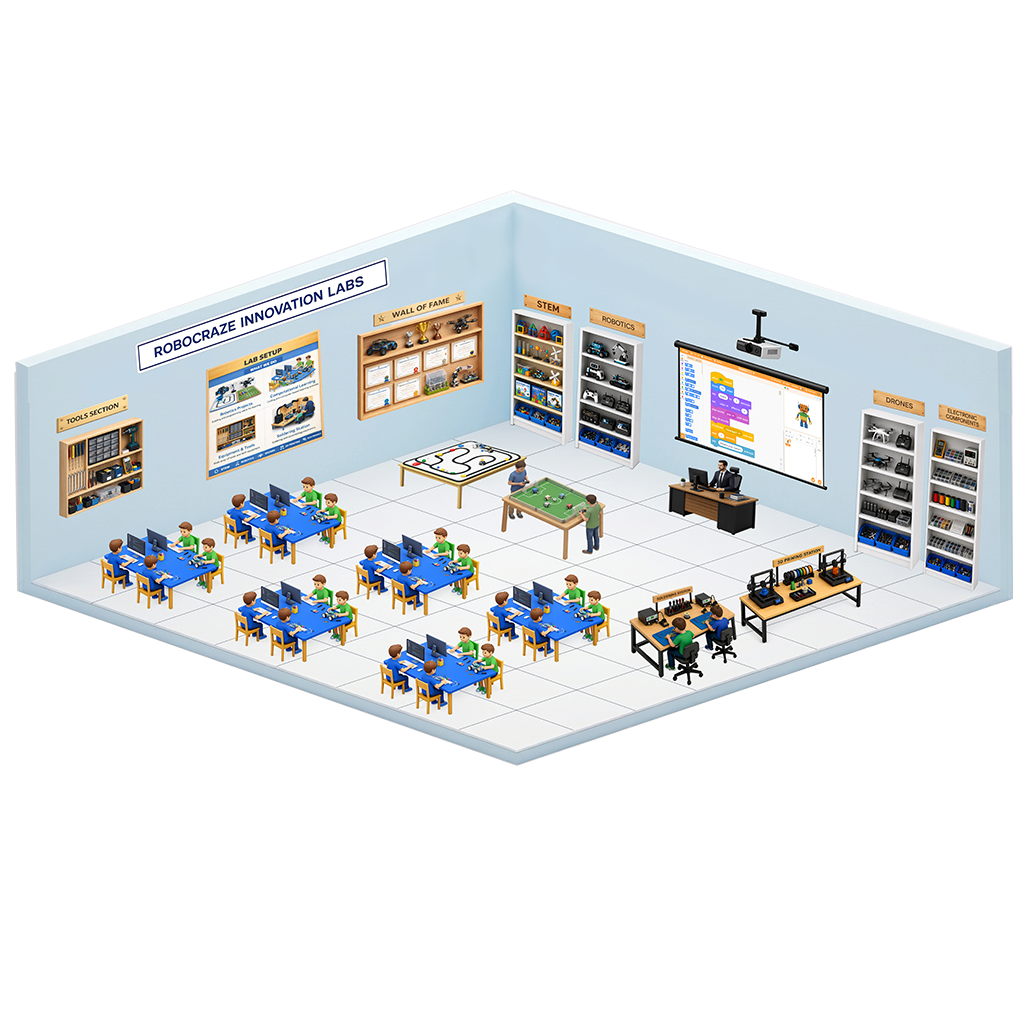
KEY FEATURES OF DRONE LAB
Hands-On Experience
Students gain enhanced hands-on experience, learning by doing, and even product visualization, bridging the gap between theoretical knowledge and practical application.
Comprehensive Skill Development
The Lab equips students with essential 21st-century skills, including Critical Thinking, Problem Solving, Design Thinking, Collaboration, Communication, Lifelong Learning.
Innovative Learning Environment
As a common facility within the institution, the Lab promotes an innovative learning environment that encourages students to think outside the box and develop creative solutions.
Idea to Prototype
Take flight from initial aerodynamic designs to fully operational UAV prototypes. Utilize advanced simulation software and physical assembly stations to build and test custom drones.
Educational Model
A specialized approach to aerospace and autonomous vehicle education. This setup provides a proven framework for universities aiming to lead in aviation technology training.
Transform Engineering Education with Drone Labs
Drone Labs make learning more practical and fun. They help students build skills like creativity, problem-solving, and teamwork. Aligned with NEP 2020, they empower students and faculty to ENGAGE, EXPLORE, EXPERIENCE, EXPRESS, and EXCEL.
Contact Our Lab Experts For Free Consultation
Get in touch with our specialist consultants for personalized design guidance.
Vasavi P
Lab Setup SpecialistTreeza George
Education SpecialistLab Activities
- Use small screwdrivers to bolt plastic arms and tiny motors onto a drone frame.
- Practice flying on a computer simulator using real radio controllers before touching the real thing.
- Learn the official government safety rules on where you can and cannot fly outdoors.
- Wire up cameras to the drone so you can see where it's flying on a TV screen.
- Fix broken propellers and replace dead batteries after a crash.
- Type code into a laptop to make the drone fly in a square shape automatically without a controller.
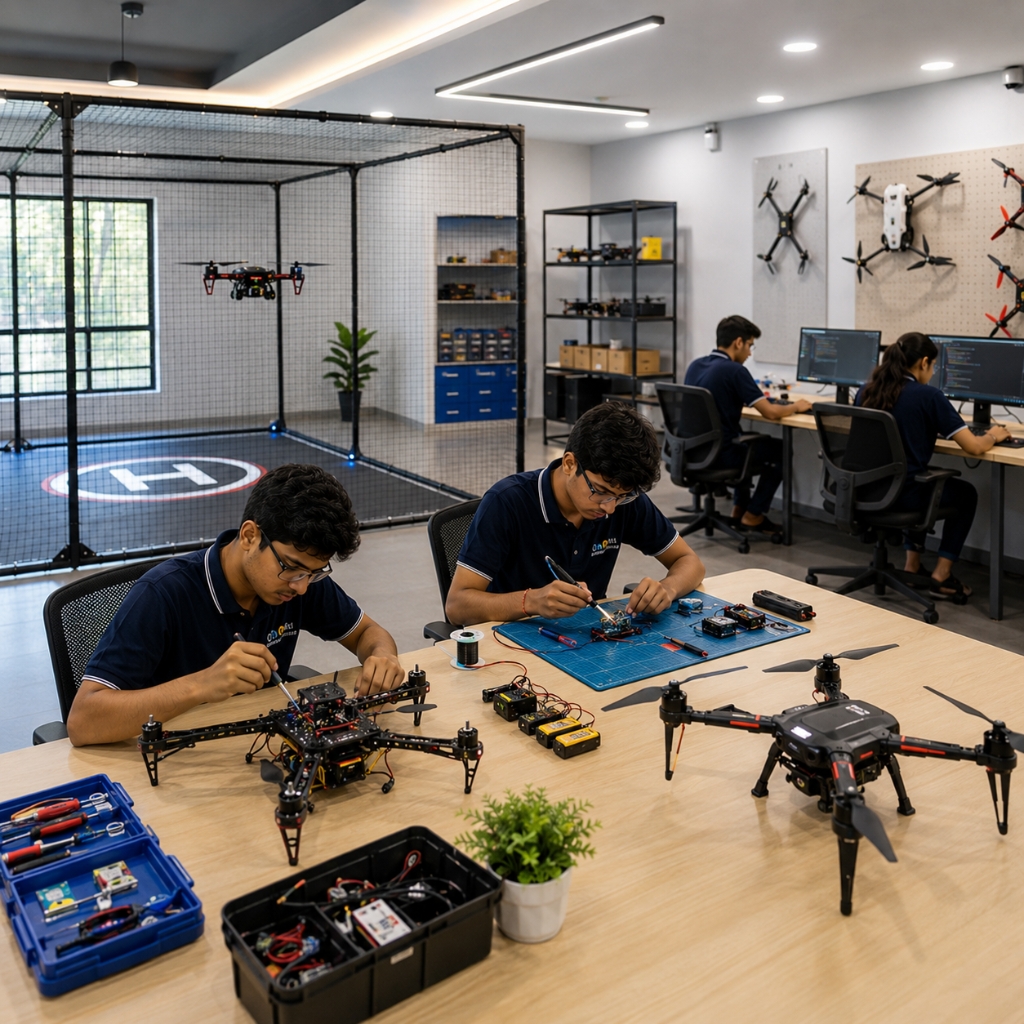
Ready to Fly
Build & Test
Drone Lab Requirements
Comprehensive guidelines and mandatory requirements for setting up and operating a Drone Lab.
Lab Infrastructure
According to guidelines, Drone Labs require a minimum dedicated space of 500 sq. ft.
- Spacious environment for safe drone assembly, calibration, and testing.
- Adequate netting or enclosed flying arena for indoor flight practice.
- Access to an open outdoor flying zone for advanced flight sessions.
- Proper furnishing, workstations, charging stations, and safety equipment.
Operational Requirements
Requirements extend beyond physical space. Drone Labs are meant to foster aerospace innovation.
- Requires clear vision, implementation plan, and faculty training in UAVs.
- Must organize drone building workshops, flight training, and hackathons.
- Institutional commitment to integrate aerotech into the curriculum.
- Ensure support staff and DGCA (Civil Aviation) safety compliance.
Product & Equipment
Comprehensive inventory designed to deeply support drone education and aerial projects.
- Drones: Nano drones, quadcopters, hexacopters, and fixed-wing models.
- Electronics & Prototyping: Flight controllers, BLDC motors, ESCs, 3D printers.
- Advanced Tech: RC transmitters, FPV goggles, telemetry radios.
- Mandatory List: Lipo batteries, balance chargers, simulators.
Events We Support
By integrating the Drone Lab into your institution, you are not just enhancing the educational experience of your students; you are bringing hands-on learning in aerial technology and preparing them to be the innovators of tomorrow.
Drone Piloting Programs
Hands-on drone flight training.
UAV Assembly Bootcamps
Intensive sessions on building drones.
Drone Design Workshops
Fostering innovation in UAV engineering.
Drone Industry Internships
Real-world aerotech work experiences.
Faculty Training in Aerotech
Empowering educators with modern tools.
Aerial Mapping Courses
Advanced GIS and aerial surveying.
Drone Tech Showcases
Showcasing student projects and innovations.
School Outreach Programs
Educating schools on aerial technology.